The short answer
Both are good roofs when they are installed well. Most Raleigh buildings could use either one. The choice comes down to a few questions about your building, and the inspector can answer most of them in one visit.
Serving Raleigh and nearby areas
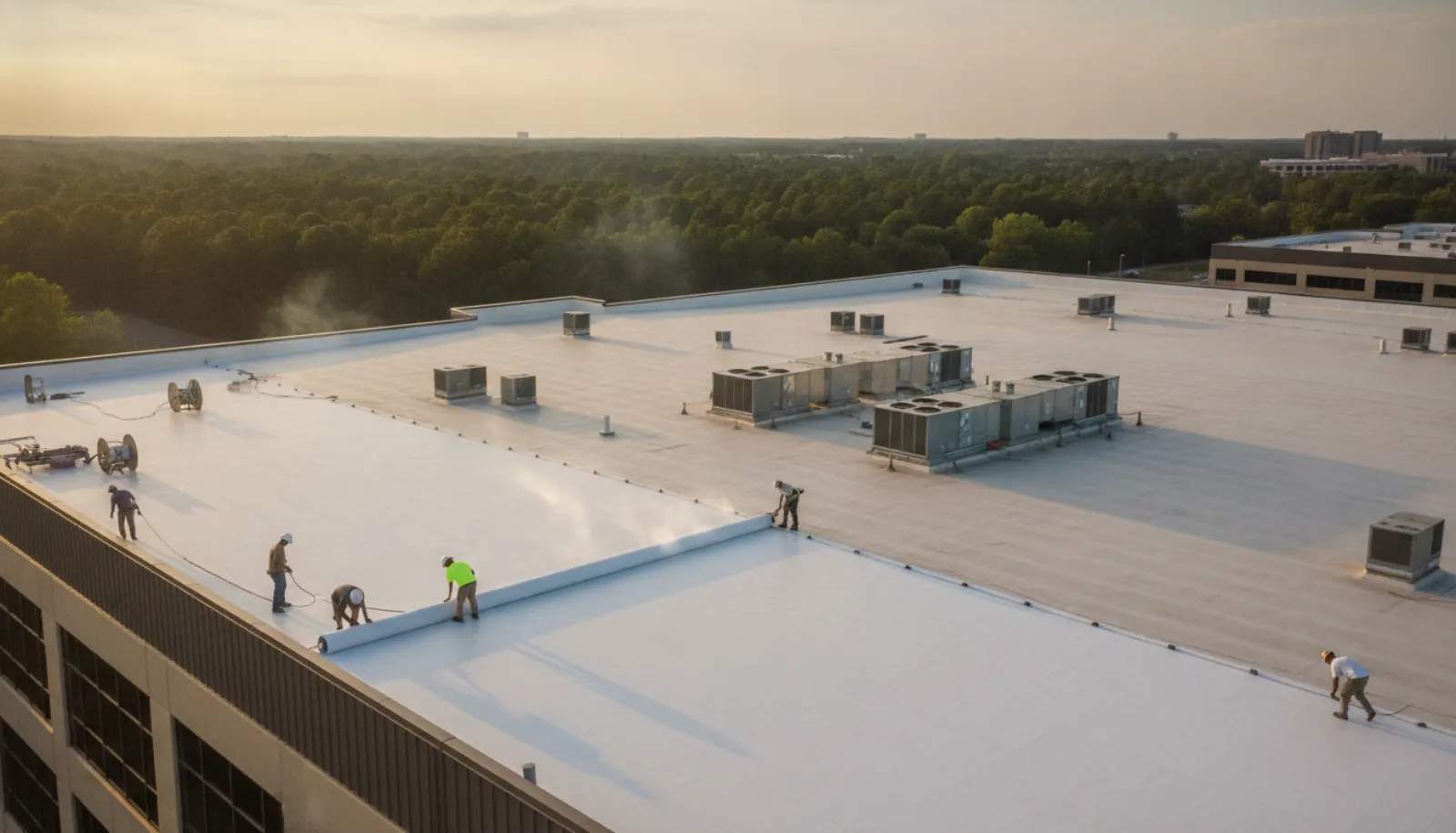
White TPO and black EPDM are the two most common flat roofs in Raleigh, and the right pick depends on your building, not a brand, so call (984) 464-8602 for a free inspection and written prices for both.
Got it. Your request is in.
Need help sooner? Call (984) 464-8602.
We connect property owners in Raleigh and nearby areas, including Research Triangle Park, Durham, Cary, Morrisville, Apex and Holly Springs, with one independent local commercial roofing specialist.
Long, hot summers
Normal July highs at Raleigh-Durham sit near 91 degrees. ENERGY STAR notes a clean white roof can stay about 50 degrees cooler than a grey roof on a summer afternoon.
No third roof
North Carolina code does not allow a new roof over a water-soaked roof or over two existing roofs. That decides whether you can lay TPO or EPDM over the old one.
Typical published ranges for Raleigh. The contractor's written estimate is the price, and the inspection is free.
| Work | Typical range |
|---|---|
| New TPO roof, installed | $4.50 to $14per sq ft |
| New TPO roof, installed | $450 to $1,400per square (100 sq ft) |
| New EPDM roof, installed | $4.25 to $12per sq ft |
| New EPDM roof, installed | $425 to $1,200per square (100 sq ft) |
| Tear-off of the old roofAdded when the old roof comes off | $1 to $2per sq ft |
Both are good roofs when they are installed well. Most Raleigh buildings could use either one. The choice comes down to a few questions about your building, and the inspector can answer most of them in one visit.
Is the space under the roof air-conditioned?
If yes, white TPO's cooler surface helps the most. In an unconditioned warehouse, it matters much less.
How much roof insulation is there?
Thin insulation and a big cooling load make reflectivity worth more.
How much foot traffic does the roof get?
Busy roofs with many rooftop units see more scuffs and cuts.
Is there a restaurant tenant?
Grease from exhaust fans damages EPDM.
What is on the roof now?
Matching the old system can make repairs and tie-ins simpler.
How long will you own the building?
A short hold may favor the lower first cost. A long hold may favor the thicker sheet and longer warranty.
Color and heat. TPO is usually white. EPDM is usually black. In a Raleigh July, with normal highs near 91 degrees, that is a real difference. ENERGY STAR notes a clean white roof can stay about 50 degrees cooler than a grey one on a summer afternoon. A cooler roof means less heat moving into the building, and less heat wear on the roof.
Seams. TPO seams are welded with hot air, which joins the two sheets into one. EPDM seams are glued or taped. Welded seams are often described as stronger. EPDM comes in wide rolls, so it can have fewer seams overall. On an older EPDM roof, seam tape that dries out is a common leak point.
Punctures and traffic. Guides generally rate TPO as tougher against punctures and impacts. EPDM is flexible and easy to patch, but can be cut more easily in high-traffic areas. On a roof with many units and frequent service calls, walkway pads help either system.
Grease. Study guides for roofing contractors note EPDM is badly affected by petroleum products and animal fats. Over a restaurant, ask about a grease-rated membrane and grease guards at each exhaust fan.
Repairs. EPDM is simple to patch with primer and tape. TPO repairs need a hot air welder and a clean, fresh surface to weld to. Old, weathered TPO can be harder to weld, so the crew may need to clean it well or use a cover strip.
Life span. Published guides disagree on which lasts longer. Ranges from about 15 to 30 years show up for both. Thickness, how the roof is attached, the quality of the install and how often it gets checked matter more than the label.
Raleigh sees tropical storm wind in some years. Hurricane Fran in 1996 caused over $900 million in property damage in Wake County alone, according to the National Weather Service. Either membrane can be fully glued, screwed down, or held with ballast stone. The attachment and the edge metal decide how well a roof holds in wind, more than TPO or EPDM. Ask each contractor how they plan to attach the roof at the edges and corners.
Typical installed ranges from a published national cost guide put TPO at about $4.50 to $14 per square foot, or $450 to $1,400 per square. EPDM runs about $4.25 to $12 per square foot, or $425 to $1,200 per square. If the old roof has to come off, tear-off adds about $1 to $2 per square foot, according to a TPO cost guide.
The ranges overlap. On most jobs, thickness, insulation, tear-off and access move the price more than the membrane.
Ask each contractor to list:
If one estimate is much lower, the list usually shows why.
The cost table shows typical ranges from HomeAdvisor's published membrane roofing cost guide and a TPO cost guide. They are not quotes.
Call (984) 464-8602 or send the form with the address. A local commercial roofer is set up the same day you call.
White TPO reflects much of the sun, so the roof runs cooler and so does the space under it. That helps most on air-conditioned buildings with thin roof insulation. On an unheated, uncooled warehouse, the cooling benefit matters less.
Published guides disagree. Some give EPDM 25 to 30 years or more with good care, and TPO 15 to 20 years. Others say the reverse. Thickness, how the roof is attached, workmanship and upkeep matter more than the label.
Published national guides put both in a similar range. TPO runs about $4.50 to $14 per square foot installed and EPDM about $4.25 to $12. Tear-off, insulation and thickness move the price more than the choice between the two.
Sometimes. If the old roof is dry and there is only one roof on the building, a new roof can often go over it with a cover board. North Carolina code does not allow a new roof over a water-soaked roof or over two existing roofs.
Yes. Grease from kitchen exhaust fans attacks EPDM. Around grease exhaust, ask about TPO rated for it or a PVC membrane, and grease guards at each fan.
Yes. A white coating can go over EPDM that is dry and in fair shape. It also covers small cracks and worn spots. Ask about the coating's warranty and what prep it needs.